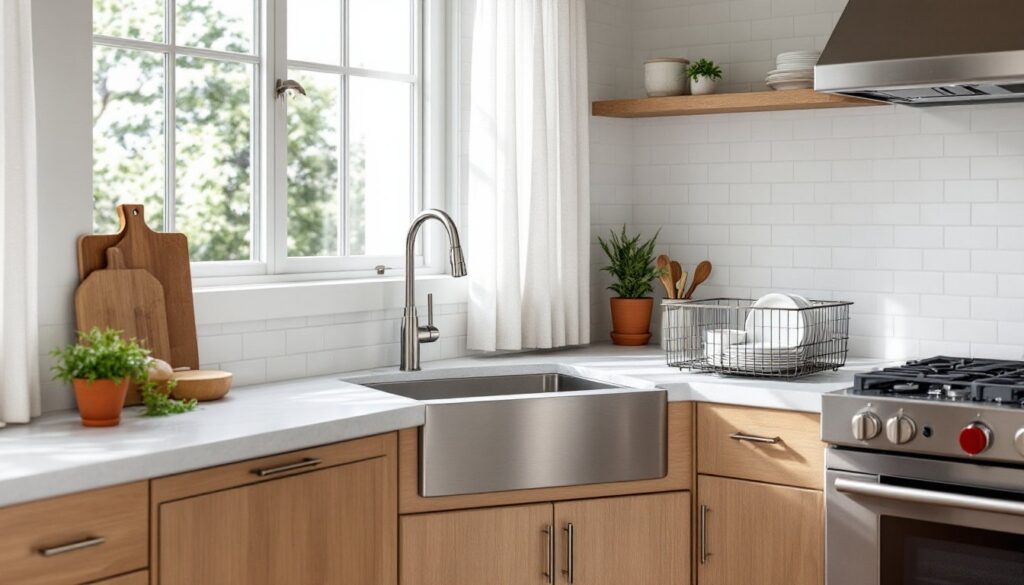
Corner sinks aren’t the most conventional choice for a kitchen, but they’re one of the smartest moves when square footage is tight or when an awkward layout needs fixing. Instead of letting a corner go dead or cramming a base cabinet with a lazy Susan you’ll never fully reach, a corner sink transforms that junction into a functional work zone. It opens up valuable counter space along the primary runs, improves workflow in smaller kitchens, and, when done right, looks intentional rather than improvised. This guide walks through why corner sinks work, which configurations suit different layouts, and what to know about cabinetry, plumbing, and design details before committing to the installation.
Key Takeaways
- Corner sink kitchen design maximizes counter space along primary walls while shortening the work triangle between sink, stove, and refrigerator in compact kitchens.
- L-shaped and U-shaped kitchen layouts are ideal for corner sinks, with positioning 18–24 inches from the corner apex and at least 36 inches of clearance for proper walkway width.
- Specialized diagonal-front or blind-corner base cabinets are required for corner sinks, and plumbing rerouting for supply and drain lines is more complex than standard installations.
- Corner sink drain lines need a minimum 1/4-inch drop per foot for code compliance, and runs longer than 8 feet may require lowering the trap or accessing the basement.
- Choose undermount stainless steel, apron-front, or composite sinks with pull-down faucets that have adequate reach, paired with continuous backsplash treatments and under-cabinet LED lighting to enhance both function and aesthetics.
- In very small kitchens under 70 square feet, carefully weigh whether a corner sink adds more counter space than storage lost before committing to the installation.
Why Choose a Corner Sink for Your Kitchen?
The biggest advantage of a corner sink is counter space liberation. By tucking the sink into the corner, continuous runs of countertop open up along both adjacent walls. That’s prime real estate for meal prep, small appliances, or even a temporary landing zone for groceries.
In tight kitchens, every linear foot counts. A corner sink placement also shortens the work triangle, the path between sink, stove, and refrigerator, because the sink naturally sits at the junction of two legs. Less back-and-forth means less wasted motion, which matters when cooking for a crowd or juggling multiple dishes.
Another benefit: corner sinks often come with a view. Position the sink on an outside wall, and whoever’s washing dishes gets a window instead of staring at a backsplash. Natural light makes the corner feel less claustrophobic, and ventilation is easier to manage.
That said, corner sinks aren’t for everyone. They can complicate cabinet access, require specialized base cabinets, and demand careful plumbing routing. If the kitchen already has efficient counter layout and plenty of storage, a standard sink placement may be simpler and cheaper. But in galley kitchens, older L-shaped layouts, or small spaces, a corner sink can be the difference between cramped and comfortable.
Best Corner Sink Configurations for Different Kitchen Layouts
L-Shaped and U-Shaped Kitchen Designs
L-shaped and U-shaped kitchens are built for corner sinks. The natural 90-degree junction is already there, no need to rework the entire footprint.
In an L-shaped layout, the sink typically sits at the inside corner where two counter runs meet. Position it 18–24 inches from the corner apex to allow room for the faucet and backsplash without crowding. This setup leaves both counter wings free for prep zones and appliances.
For U-shaped kitchens, a corner sink can go in either of the two inside corners, but the back corner is usually the better choice. It keeps the side runs open for the range and refrigerator, and the sink becomes the natural hub. If the U is tight (less than 8 feet between opposing runs), a corner sink prevents the space from feeling bottlenecked.
One critical detail: make sure there’s at least 36 inches of clearance between the sink’s front edge and any opposing cabinet or island. That’s the minimum walkway width to meet most residential codes and keep the kitchen from feeling like a hallway.
Small Kitchen and Galley Adaptations
Small kitchens and galley layouts need different thinking. A corner sink won’t always fit a true galley (two parallel runs with no corner), but in compact small kitchen corner sink ideas where an L or partial U exists, it’s often the best use of limited space.
In a small L-shaped kitchen (under 100 square feet), a corner sink can free up enough counter to add a microwave, coffee maker, or cutting board without overlap. Pair it with a single-bowl sink to maximize the usable basin size, double bowls eat up more cabinet width and can feel cramped in tight quarters.
For galley adaptations, consider an angled corner sink at the end of one run, where the galley meets another wall or opens to a dining area. This creates a partial L and gives the galley a functional endpoint instead of a dead wall.
One caution: in very small kitchens (under 70 square feet), a corner sink can steal cabinet storage faster than it adds counter space. Run the numbers on linear footage before committing. If you’re losing more than one full base cabinet’s worth of storage and don’t have a pantry or upper cabinets to compensate, a standard undermount or drop-in sink along one wall may be the safer call.
Cabinet and Storage Solutions for Corner Sinks
Corner sink cabinets are not standard stock items at most big-box stores. Most require a corner sink base cabinet, which is either a diagonal-front model or a blind-corner design adapted for plumbing.
The diagonal-front cabinet is the most common. It has a 45-degree angled face that follows the sink’s orientation. The cabinet door(s) open from the front, and the interior is a trapezoidal space. It’s easier to access than a traditional blind corner, but storage is still limited. Use this space for under-sink essentials: garbage disposal, P-trap, cleaning supplies, and maybe a small pullout organizer.
Blind-corner adaptations use a standard L-shaped cabinet pair with one side cut back to accommodate the sink basin and plumbing. This approach saves money (you can sometimes modify stock cabinets), but it sacrifices more storage and can be harder to access. If you go this route, add a pullout shelf or lazy Susan in the remaining corner space to avoid a black hole.
For drawer storage, some corner sink cabinets offer tip-out trays or shallow drawers in the false front panel. These are great for sponges, scrub brushes, and dish soap. They won’t hold much, but they keep daily-use items out of the way.
One pro tip: if the corner sink is against an exterior wall, check for HVAC ducts or electrical outlets before ordering cabinets. You may need a shallower cabinet depth (21 inches instead of the standard 24 inches) to avoid conflicts. This is especially common in older homes with baseboard heating or wall-mounted outlets.
Finally, don’t forget about the upper cabinets. If the corner sink sits below a window, you’ll lose upper storage on that wall. Plan to add open shelving, a pot rack, or taller uppers on adjacent walls to compensate.
Plumbing and Installation Considerations
Plumbing a corner sink is more involved than a standard installation, and it almost always requires rerouting supply and drain lines.
Most corner sinks need the hot and cold supply lines to run through the floor or back wall, then angle toward the sink’s off-center location. If the original sink was centered on a wall, you’re looking at extending or relocating those lines. Use 1/2-inch PEX or copper for supply lines, PEX is easier to route in tight corners and less prone to kinking.
The drain line is the bigger challenge. Corner sinks often sit farther from the main stack, so the horizontal drain run is longer. Code requires a minimum 1/4-inch drop per foot for proper drainage. Measure the distance from the sink trap to the stack and calculate the required slope. If the run is more than 8 feet, you may need to lower the trap or reroute the drain through the basement or crawlspace.
For homes on a slab foundation, rerouting drains can mean cutting concrete and adding a new cleanout. That’s a job for a licensed plumber in most jurisdictions. Don’t attempt it without a permit, drain work is covered under the International Plumbing Code (IPC) and local amendments, and inspectors will flag unpermitted modifications.
Garbage disposals add weight and complexity. Make sure the corner sink base cabinet has enough clearance below the basin for the disposal unit and P-trap. Some corner sinks have shallow bowls to fit tighter spaces, which can limit disposal options. Check the sink’s bowl depth (measure from the bottom of the basin to the drain opening) and compare it to the disposal’s mounting flange height.
If the corner sink sits on an exterior wall with a window, vent the drain properly. You may need a loop vent or air admittance valve (AAV) if a traditional vent stack isn’t accessible. AAVs are code-compliant in most areas, but verify with your local building department before installation.
One last note: always use a basket strainer or grid in the sink to catch debris. Corner sinks with long drain runs are more prone to clogs because food particles have farther to travel. A good strainer reduces service calls and keeps the plumbing running smoothly.
Design Tips to Make Your Corner Sink Both Functional and Beautiful
A well-designed corner sink doesn’t just work, it looks like it belongs there.
Start with the sink material and style. Undermount stainless steel is the workhorse choice, durable, easy to clean, and budget-friendly. For a more finished look, consider a farmhouse-style apron-front sink in fireclay or cast iron. Apron-front corner sinks are less common (you may need to special-order), but they add visual weight and anchor the corner.
Composite granite or quartz sinks are another option. They resist scratches and stains better than stainless, and the matte finish hides water spots. Match the sink color to the countertop for a seamless look, or go one shade darker for subtle contrast.
For the faucet, choose a model with a pull-down or pull-out sprayer and a high-arc spout. Corner sinks often have less surrounding counter space, so a flexible sprayer lets you rinse outside the basin. Make sure the faucet reach (the distance from the spout to the farthest edge of the spray pattern) covers the entire sink, measure before buying.
If the corner sink sits below a window, keep the faucet height low enough to clear the sash when it’s open. A wall-mounted faucet is an elegant solution that frees up deck space and works with any window height, but it requires plumbing lines run through the wall, add that to the scope if you’re already opening walls.
Backsplash and countertop treatments matter. Run the backsplash continuously along both walls that meet at the corner. A diagonal backsplash panel behind the sink ties the two runs together and protects the corner from splashes. Use the same material as the main backsplash (subway tile, slab, or mosaic) for a cohesive look.
For countertops, miter the corner seam at 45 degrees if using stone, quartz, or butcher block. A well-cut miter makes the corner look like one continuous piece. Laminate countertops typically use a corner cap or molded corner piece, less seamless, but functional and cost-effective.
Lighting is critical. A corner sink can fall into shadow if it’s far from the main ceiling fixture. Add an under-cabinet LED strip along both adjoining walls, or install a recessed can light directly above the sink. Position the can 12–18 inches out from the corner to avoid shadows from the faucet.
Finally, accessorize smartly. A corner sink caddy or over-the-sink cutting board adds function without cluttering the counter. If the sink has a single large bowl, a bottom grid protects the basin from scratches and keeps dishes elevated for better drainage. Many design sourcebooks on Remodelista showcase curated sink accessories that blend utility with aesthetics.
For those planning a full remodel, browsing professional contractor portfolios on Houzz can provide layout inspiration and connect homeowners with local pros who specialize in corner sink installations. Real-world examples often reveal smart solutions that aren’t obvious from product photos alone.