Bathroom tile sets the tone for the entire space, it’s one of the first things you notice when you walk in, and it’s also one of the hardest-working surfaces in your home. Whether you’re tackling a full gut renovation or freshening up a powder room, the right tile choice can elevate a builder-grade bathroom into something that feels custom and intentional. The good news? You don’t need a massive budget or a contractor on speed dial to pull off a tile design that looks expensive and holds up over time. From classic subway configurations to bold geometric patterns and textured natural stone, there’s a style and layout to fit every skill level and aesthetic.
Key Takeaways
- Bathroom tile design ideas range from timeless subway layouts to bold geometric patterns and natural stone, allowing homeowners to elevate their space without requiring a massive budget.
- Grout width, color, and tile layout patterns significantly impact the overall aesthetic—darker grout hides stains better, while oversized subway tiles create a sleeker, more seamless appearance with fewer grout lines.
- Natural stone tiles like marble and travertine offer stunning character but require annual sealing and careful maintenance, whereas high-quality porcelain stone-look tile replicates the beauty without the upkeep demands.
- Strategic use of accent walls and feature showers allows you to incorporate expensive or labor-intensive tile styles while keeping overall costs manageable by using affordable neutral tile for the majority of surfaces.
- Large-format tile (12″ × 24″ or larger) minimizes grout lines for a contemporary look but requires a perfectly flat substrate, while proper substrate preparation and waterproofing are essential for any tile installation to last.
- DIY-friendly tile projects should focus on simple formats like standard subway or 12″ × 12″ field tiles, and investing in a wet saw rental ($50–$70/day) can make cutting harder porcelain tiles manageable for homeowners.
Timeless Subway Tile Layouts and Modern Twists
Subway tile (3″ × 6″ ceramic or porcelain rectangles) remains a go-to for good reason: it’s affordable, widely available, and forgiving to install if you’re a first-timer. The standard running bond layout, each tile offset by half, is clean and classic, but there are plenty of ways to add personality without reinventing the wheel.
Try a vertical stack bond (tiles aligned in straight columns) for a modern, streamlined look that visually lifts low ceilings. Herringbone and chevron patterns add movement and work especially well in shower niches or behind freestanding tubs. Keep in mind chevron requires tiles cut at precise angles, so factor in extra material waste and time if you’re cutting them yourself.
Grout width matters more than you’d think. A standard ⅛” joint reads traditional: going down to ¹⁄₁₆” (rectified tile only) or up to ¼” can shift the entire vibe. Darker grout adds contrast and hides staining better in high-use areas like tub surrounds, but it also emphasizes every line, make sure your layout is square and your spacers are consistent.
For a contemporary twist, consider oversized subway tiles (4″ × 12″ or even 4″ × 16″). They cover more area per piece, which speeds up installation and creates fewer grout lines for a sleeker, more seamless appearance. Pair them with matte black fixtures and a monochrome palette for a look that feels current but won’t date quickly.
Bold Patterned and Geometric Tile Designs
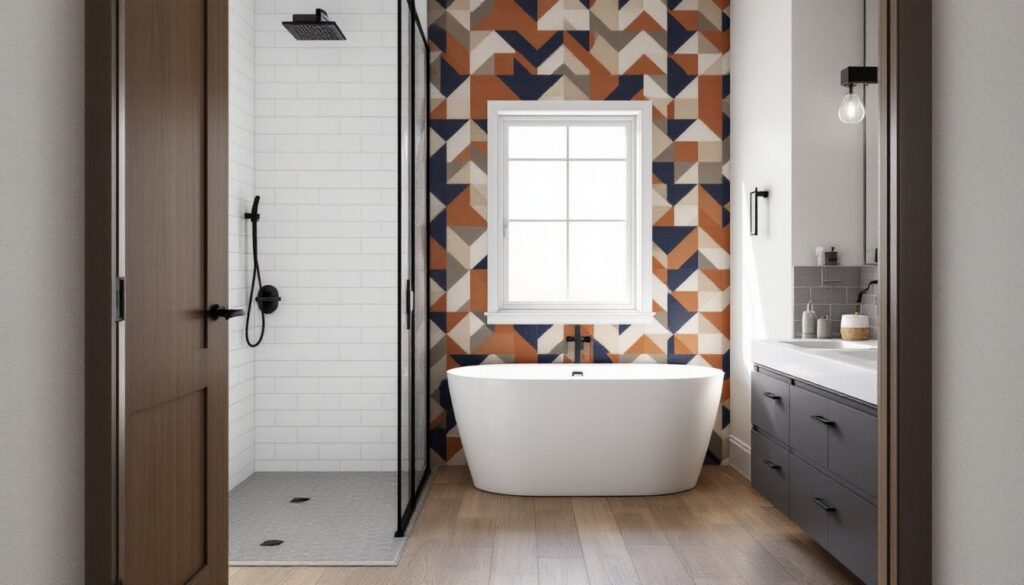
If you want a bathroom that doesn’t look like every other flip on the block, patterned cement tile or encaustic-look porcelain brings serious visual interest. These tiles often feature intricate Moroccan, Spanish, or Art Deco motifs in multiple colors. They work best as a focal point, think a feature wall behind a vanity or a defined shower floor, rather than covering every surface, which can overwhelm a small room.
Cement tile is porous and requires sealing (both before and after grouting), plus it’s prone to etching from acidic cleaners. If you love the look but want lower maintenance, go with porcelain replicas that mimic the color variation and matte finish without the upkeep. Many design inspiration platforms showcase how homeowners pair bold floor patterns with simple white or neutral wall tile to balance the space.
Hexagons, diamonds, and zellige-style tiles add dimension and a handcrafted feel. Large-format hexagons (8″ or 10″ face-to-face) are easier to install than penny rounds and still deliver geometric impact. Smaller formats like 2″ hexagons create more grout lines, which means more labor and more opportunity for lippage (uneven tile edges), use a quality thin-set mortar with good open time and consider a ¼” square-notch trowel for even coverage on mesh-backed sheets.
Safety note: Wear a respirator rated for silica dust when cutting any porcelain or cement tile. A wet saw minimizes airborne particles, but you’re still generating fine dust that’s harmful with repeated exposure.
Natural Stone and Textured Tile Options
Natural stone, marble, travertine, slate, and limestone, brings warmth and one-of-a-kind veining that you can’t replicate with manufactured tile. It’s also more temperamental. Most stone is porous and needs a penetrating sealer applied before grouting and reapplied annually, especially in wet areas. Marble looks stunning but etches easily from shampoo, soap, and hard water, so it’s better suited to low-splash zones like accent walls or floors in powder rooms.
Travertine offers a rustic, textured surface with natural pitting. Honed (matte) finishes are less slippery underfoot than polished, which is critical for shower floors. For slip resistance, pair stone tile with a textured or tumbled finish, or size down to smaller formats (2″ × 2″ or mosaic sheets) that increase grout joint coverage and improve traction.
If you want the look of stone without the maintenance, porcelain stone-look tile has come a long way. High-quality versions replicate marble veining, slate texture, and even the subtle color shifts of limestone. They’re denser, nonporous, and suitable for both walls and floors. When comparing products, check the PEI rating (Porcelain Enamel Institute abrasion resistance), PEI 3 or higher works for residential bathroom floors.
3D textured tiles, wave patterns, stacked ledger stone, or ribbed surfaces, add tactile interest and play with light in ways flat tile can’t. These work well as shower accent strips or behind floating vanities. Be aware that deep textures collect soap scum and water spots more readily, so they’re not ideal for the entire shower enclosure unless you’re committed to regular cleaning. Use a pH-neutral cleaner to avoid damaging sealers or grout over time.
Creative Accent Wall and Feature Shower Ideas
An accent wall gives you permission to use a pricier or more labor-intensive tile without blowing the budget. Popular placements include the wall behind a freestanding tub, a full-height shower back wall, or the section behind a floating vanity. This approach also lets you mix materials, pair a bold geometric cement tile wall with simple white subway on the other three sides, or combine textured stone with large-format porcelain slabs.
For showers, consider a floor-to-ceiling feature wall in a contrasting color, finish, or pattern. A vertical stripe of mosaic tile or a panel of marble book-matched slabs creates a focal point and visually stretches the height of the room. If you’re working with a standard 60″ tub/shower combo, extending tile all the way to the ceiling (rather than stopping at the showerhead) makes the space feel more finished and prevents that builder-grade cutoff line.
Niche tile treatment is another opportunity for contrast. Line a recessed shower niche with the same accent tile used elsewhere, or go with a waterproof bullnose trim or Schluter edge profile in a metallic finish for a clean, integrated look. Make sure the niche is sloped slightly toward the shower (about ⅛” per foot) so water doesn’t pool on the shelf.
When mixing tile types on the same wall, plan your layout so transitions happen at inside corners, changes in plane, or along grout lines, not mid-wall where they’ll look like an afterthought. Use the same grout color across both materials for visual continuity, and make sure your substrate is appropriate for each tile type (cement board for ceramic/porcelain, a waterproof membrane system like Kerdi for natural stone in wet areas). Many remodeling project guides highlight how professionals sequence mixed-material installations to avoid rookie mistakes.
Floor Tile Patterns That Make a Statement
Floor tile sets the foundation (literally) for your bathroom’s design. Beyond picking a color or finish, the layout pattern dramatically affects how the room reads. Diagonal layouts make small bathrooms feel larger by drawing the eye along the longest sightline, but they generate more cuts at walls and transitions, budget an extra 15–20% for waste.
Large-format tile (12″ × 24″, 24″ × 24″, or even 24″ × 48″ planks) minimizes grout lines for a sleek, contemporary look and faster installation. The trade-off: larger tiles require a flatter substrate. Any dips or humps in your subfloor or old mortar bed will telegraph through and cause lippage. Use a 6-foot straightedge to check for high and low spots, and level with a self-leveling underlayment if needed before you start. Don’t skip this step, it’s the difference between a pro-looking job and one that looks DIY in a bad way.
Wood-look porcelain planks bring warmth without the moisture issues of real hardwood. Install them in a staggered brick pattern or a more random Ashlar layout (varying plank lengths) for a realistic appearance. Make sure you’re using a modified thin-set rated for porcelain, and back-butter larger planks to ensure full coverage and prevent hollow spots that can crack under foot traffic.
For a classic, high-end look, try a basketweave or pinwheel pattern using two tile sizes, commonly 6″ × 6″ field tiles with 2″ × 2″ accent dots. This works especially well with marble or porcelain marble-look tiles. It’s more labor-intensive than a straight lay, but the visual payoff is significant. Always dry-lay your pattern before mixing mortar to confirm spacing, check cuts at walls and doorways, and catch layout issues early.
Budget-Friendly Tile Design Tips for DIY Projects
Tile can get expensive fast, but smart planning keeps costs in check without sacrificing style. Buy field tile on sale or as overstock from big-box stores or tile outlets, you’ll find name-brand porcelain and ceramic at steep discounts if you’re flexible on exact color. Calculate square footage (length × width of each surface, converted to square feet), then add 10–15% for cuts, breakage, and future repairs. For a standard 5′ × 8′ bathroom with a tub surround tiled to 6′ height, you’re looking at roughly 180–200 square feet of wall tile plus another 40 square feet for the floor.
Use affordable white or neutral tile for the majority of surfaces, then splurge on a small amount of accent tile where it counts, a single feature wall, a stripe at eye level, or a decorative border. This approach mimics what designers do on higher-end projects and keeps your cost per square foot reasonable.
DIY-friendly formats include standard subway tile, 12″ × 12″ or 12″ × 24″ field tiles, and mosaic sheets on mesh backing. Avoid tiny individual mosaics or complex patterns that require precision cutting unless you’ve got tile experience. A manual tile cutter (score-and-snap style) handles straight cuts on ceramic and softer porcelain and costs around $40–$80. For notches, curves, or harder porcelain, rent a wet saw (about $50–$70/day at most home centers) rather than buying one for a single project.
Grout color makes a big impact for minimal cost. White or light gray grout is forgiving and brightens small spaces, while charcoal or black grout adds contrast and hides staining in high-traffic showers. Epoxy grout is more expensive and trickier to work with (it sets fast and requires immediate cleanup), but it’s stain-proof, doesn’t need sealing, and lasts longer in wet areas, worth considering if you’re tiling a shower floor or around a tub.
For cost estimates and planning, renovation cost guides break down material and labor by region and project scope. Remember that tile is only part of the budget, you’ll also need thin-set, grout, backer board or waterproofing membrane, spacers, and tools. If your bathroom hasn’t been updated in decades, factor in possible repairs to subfloor, plumbing access, or framing before tile even goes up.
Conclusion
Tile is one of the most permanent decisions you’ll make in a bathroom remodel, so it pays to plan carefully and install correctly. Whether you’re drawn to the clean lines of subway tile, the drama of bold patterns, or the organic feel of natural stone, there’s a style and layout that fits your skill level and budget. Take your time with surface prep, invest in the right tools, and don’t skip waterproofing or proper substrate work, those unsexy steps are what separate a tile job that lasts from one that fails in a few years.